Is your knowledge base ready for an AI assistant?
By William Schimensky · Published · Updated
Before connecting an AI assistant, check whether your knowledge sources are authoritative, readable, permission-aware and testable at retrieval time.
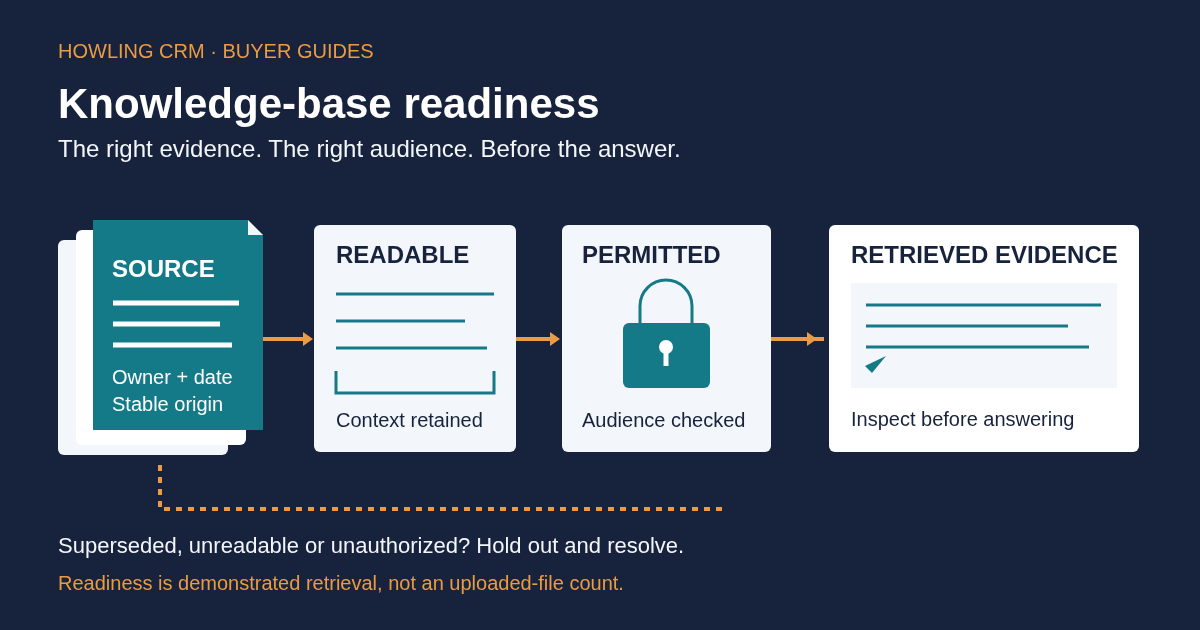
Text description
Register each source's owner, authoritative location, effective date and audience. Resolve superseded versions and inspect extracted passages for intact context. Apply the actual document-access mechanism to the requesting identity before exposing passages, titles or citations. Inspect retrieved evidence before judging an answer; an uploaded-file count does not establish readiness.Evidence before answers
An AI assistant cannot reliably answer from information your business has never written down. Less obviously, it can also struggle when the answer exists but sits inside contradictory documents, unreadable scans or pages intended for a different audience. Before comparing conversational features, examine the collection of material the assistant will retrieve. The practical question is not “Do we have a knowledge base?” It is “Can the system find the right, current, permitted evidence for a specific question?”
Define the collection before connecting it
Retrieval-augmented generation, often shortened to RAG, grounds model responses in retrieved content. Microsoft's technical overview describes challenges including query understanding, information spread across sources, limited input capacity and access control. Connecting more folders does not resolve those problems by itself.
Start with a source register. For each collection, record its owner, intended audience, authoritative location, review date and permitted uses. Separate approved policies from brainstorming notes, draft proposals and historical records. Identify which material should answer customer questions and which should remain available only to staff. A directory full of useful documents is not yet an approved retrieval corpus.
Resolve contradictions at the source
Ask a content owner to review overlapping answers before ingestion. A current returns policy and an archived announcement may both look relevant to a search system. If they disagree, the assistant needs an explicit basis for choosing the current rule; polished wording will not repair the conflict.
Give each policy a stable identifier, effective date and responsible owner. Mark superseded versions and decide whether to exclude them or retain them in a separate historical collection. Replace vague references such as “the usual fee” with the actual rule or a maintained authoritative reference. Record exceptions alongside the rule they qualify, rather than in an unrelated meeting note.
Check what the machine can actually read
Inspect the extracted text, not just the original document. A clean-looking PDF may yield scrambled table columns. A scanned policy may require optical character recognition. A diagram may lose the relationship between labels and arrows. Ask the implementer to show the text that reaches the retrieval index for representative files.
Long documents are often divided into smaller passages, or chunks. Microsoft documents chunking as a way to meet model input limits and avoid truncation. That does not establish one universally correct chunk size.
Review whether each passage retains enough context to stand alone. A paragraph describing an exception should preserve the relevant product, location and eligibility conditions. Keep titles, source links and section labels attached so reviewers can trace retrieved material back to its origin.
Make permissions part of retrieval
A shared search index must not turn restricted material into general knowledge. Define access by audience and test with representative identities. Can a customer retrieve an internal discount policy? Can one team retrieve another team's confidential procedures? Does a document's access change reach the retrieval layer?
Microsoft's documentation distinguishes several document-level access-control approaches, including security filters and identity-based mechanisms. These are implementation choices, not a guarantee that every connector automatically preserves source permissions. Ask which mechanism applies to your actual sources and deployment.
Also inspect titles, snippets and citations. A refusal in the final answer is insufficient if the system already exposed a restricted document name or passage.
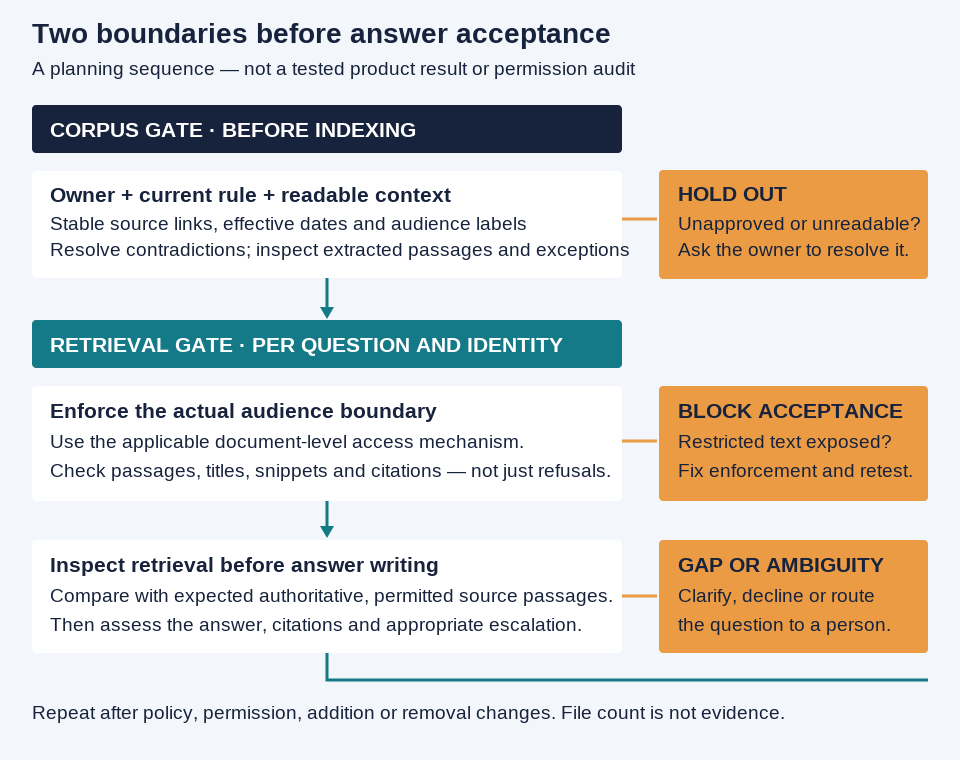
Text description
Before indexing, require authoritative owners, current rules, stable source links, effective dates, audience labels and readable passages with necessary exceptions. Hold draft, obsolete or unreadable content out until its owner resolves it. At query time, enforce the applicable document-level access mechanism for the requesting identity; check snippets, titles, citations and passages as well as the final answer. Restricted evidence blocks acceptance and requires enforcement repair and retesting. Compare retrieval with expected authoritative, permitted passages before reviewing answer writing. For missing or ambiguous evidence, clarify, decline or route to a person. Repeat checks when policies, permissions or corpus membership change. This is planning guidance, not a product test or permission audit.Test retrieval separately from answer writing
Build a small evaluation set from real questions. Include common phrasing, abbreviations, ambiguous requests, recently changed rules and questions the corpus cannot answer. For each question, record the expected source passage and which audiences may access it.
First inspect what the system retrieves. Did it find the authoritative passage? Did it miss a necessary exception? Did it return an obsolete version? Only then review the generated answer. This separation helps distinguish a content gap from a search problem or an answer-generation problem.
Include negative cases: questions outside scope, missing information and requests for restricted material. Define when the assistant should ask a clarifying question, decline to answer or send the question to a person.
Set a readiness gate, not a document target
Readiness is not measured by uploaded file count. Require evidence that approved sources are readable, conflicts are resolved, permissions work and representative questions retrieve the expected material. Set an update target for changed policies and test removal as well as addition.
Use the customer support category to identify relevant listings, including Botpress and Intercom, or review Glean for workplace knowledge use cases. Treat those links as starting points, not certifications. Bring the same source register and retrieval tests to each discussion.
References and verification
Official Microsoft technical documentation checked 2026-10-31 through verified HTTPS retrieval; the RAG overview, chunking and document-level access sources remain substantive for the stated scope. This is corpus-readiness guidance, not a product test, permission audit or endorsement.
Public sources
- Microsoft: RAG overview — retrieved-content grounding; challenges involving sources, input limits and authorization
- Microsoft: Chunk documents — segmentation addresses input limits and truncation; no universal chunk-size guarantee
- Microsoft: Document-level access control — security filters and identity-based approaches; preview options are not universal capabilities
General information only, not legal, medical or compliance advice. Spotted an error? Request a correction.